Tuesday, March 8, 2016

#WeirdEd Week 98- Doctor Who


Right up front let's get this out of the way- Doctor Who can seem impenetrable to the uninitiated. There's 50 years of canon to sift through, though you really only need to have started watching in the last ten, and it's built for you to jump on every few years with a new Doctor (I'll get to that in a second). If you're not a Who fan then the whole thing probably seems quiet silly.

And it kind of is. Which is kind of the point.

I want to be clear that, much like every other chat on some specific fandom or thing I love but I acknowledge much of my audience might not, I'm going to do my best to a) explain the basics of what you need to know here and b) write questions that are accessible even if you don't know what a Dalek, Cyberman, TARDIS, or Adipos is. You have to trust me, tonight I'm the Doctor.

A brief overview- The Doctor is a Timelord, an ancient race of aliens who live what might as well be forever through regeneration. When the body of a Timelord dies she or he regenerates into a new body. To put it in TV terms, when an actor wants to leave the show the writers can kill him and replace him without killing the character. No matter what face The Doctor wears, he's always The Doctor. Different actors put different spins on him, but he is the same character the whole time. We are on our 13th Doctor (nerds will note that I'm counting the War Doctor because of course I am).

The Doctor travels through space and time in a ship that looks like a blue police call box called the TARDIS. It looks like a blue police call box in the show because the chameleon circuits are broken and in practical terms because the BBC gave the show zero budget and a blue box is an easy prop. The TARDIS is "bigger on the inside" because science and otherwise our heroes are trapped in a tiny box and that's no fun at all.

The Doctor is almost always accompanied by a Companion. The companion is a human (or humans) who he travels with and shows off for and rescues and cares for. In practical terms, the companion begins as the audience surrogate, our window into this insane world, and eventually, when written right, we care for and love the companion like he does. The companion will make you cry.

The Doctor travels time and space saving people, solving mysteries, defeating aliens, and bringing peace. He doesn't use weapons aside from his mind and a sonic screwdriver, which is a magic wand that does  whatever science the show needs (except it doesn't work on wood). He's manic and joyful and brooding and the loneliest person in the galaxy because he's the last of his kind (sort of). He talks fast, runs down corridors, and scares the bejesus out of most other aliens. The Doctor fights with only his mind and his will, this is important. He faces down metaphors for communism and Nazis regularly, but he doesn't shoot them. He will outwit, outrun, out-think them, and sometimes just straight up bluff.

The Doctor isn't always the best teacher because he's the smartest person in any room he's in and he knows it and in fact he relishes it. The Doctor often finds himself in a bind with no possible way to get out of it but he does, and why? Because he knows he will. He is endlessly curious. He has to be, he can see all of space and time. Puzzles with no answer are the most interesting (yes, he's got a Sherlock thing a little- written by the same guy at the moment- but there's one major different between the to. The Doctor loves people. Sherlock couldn't care less about them.). The Doctor is not cool and most of the time he doesn't try to be. Depending on which Doctor you're talking about he is handsome or craggely, young or old, excited or dour. But he's always wise and always trying to be better. He has things in his past he can't forget and forever regrets and instead of dwelling on this he uses that fire to make the universe a better place.

There's a lot in Doctor Who for us to learn.

Everyone has a favorite Doctor and a favorite companion. I'm stealing my answer for my favorite from someone else, I can't remember who- My favorite Doctor is the one I'm with at the moment. Right now my favorite is Peter Capaldi, the current Doctor. He's old and grumpy and fantastic. But I loved the previous Doctor, Matt Smith, who was a young, excited puppy. Before him David Tenant, the handsome and charming, was the best. And before him, where I jumped on to the show when they brought it back, was Chris Eccelston, angry and wounded. I love The Doctor.

As for my favorite companion, it's easy- I love Amy Pond. She was the best. Then Rose Tyler.

Doctor Who's most recent seasons were, unfortunately, just pulled from Netflix but if you're a science fiction person or like fast-paced, joyful storytelling, I can't tell you how much you'll love the show. It's not always great, sometimes it's pretty bad (looking at you Sleep No More), but when it's on it's the best hour of TV you'll see. Don't be afraid to jump in wherever, it's accessible if you're patient. I'd go back to the restart with Chris, but that's where I started so I'm biased.

Tonight we talk Doctor Who and education. It's time to be madmen in a blue box.

**Note- there will be no #WeirdEd next week (3/16) as I will be flying to Palm Springs for the CUE 2016 National Conference. Normally I'd let someone else run it but it's week 99 and I want to do it so it's postponed. No #WeirdEd on 3/16.

Friday, March 4, 2016

This Election Is Good For Anti-Bullying Curriculum


After the most recent Republican debate (is that still the word we're using?) thinkpieces began springing up all over Twitter's Education Country. The gist is simple- "This Election Hurts Anti-Bullying Curriculum."

First, let's be clear. We're not talking about the entire election. We're not talking about a select group who's support of one candidate has gotten a little, let's say, aggressive against the stated wishes of the candidate they're being aggressive for. When articles lead with, "the presidential campaign" they are being disingenuous. We're all talking about His Orangeness and the Two Stooges. The Democratic debates have gotten heated at times, but have almost entirely been centered around policy and even when the moderator tried to make it personal the candidates refused to engage. The last Republican debate had editors scrambling for a way to put, "Trump made reference to the size of his tower," in a headline that would get past work firewalls. I work in an elementary school and I wasn't impressed with the comebacks from Sanctimonious Second Place and Thirsty Third Place either.

Nonetheless, this display from the Grand Old Penis-reference has educators in a tizzy about What To Tell The Children. How can we teach bullying tactics when the tactics we try to prevent are so prominently on display in the contest to be the most powerful person in the free world? Why, why must these men be the model our students see? Look how much harder our job is now.

At first glance this stance bothered me from an admittedly flip perspective. I teach 5th grade and none of my kids are watching the debates closely. I'd like them to, we've mentioned them, but it's not appointment viewing for them. Are they in the room if their parents watch? Probably, and I'd hope their parents are talking about what they are seeing with them. I have no control over that, however.

The more I thought about it, though, the more I came to disagree with the stance that the Republican Insult Comedy Hour(s) is bad for schools. Not to be contrarian, but I think it's great for schools. It's an amazing chance for us to have real-world examples of actual bullies in the wild. And in contention for a position of power. This is a boon for anti-bullying lesson-planning and for a wider conversation about what it means to be a leader, what it means to debate, and how bullying can have real, long-term, damaging effects.

Here's the trick though- you have to be blatantly honest and open about what is happening. We can't dance around it. Go head-on, not from a political bent, but from a behavior one. Ask kids if they know anything about Trump's attempted erect- I mean- election. Let them bring the conversation to you. Show parts of the debacle. Pick it apart. "What do you see? What did you hear? What do you think?" Explicitly state that your purpose is to talk about how humans should treat each other and that's all.

It's not just each other they're bullying either. It's bullying writ large. Trump and his followers are openly racist, hateful, and sexist (Cruz is too, you just need to dig for thirty seconds). They're bullying wide swaths of Americans. Gay Americans. Americans of color. Muslim Americans. Women. Take a breath and use that if you're concerned about it impacting your kids, and we should be concerned. Too often we hide our heads from real education issues in favor of taking a stand on something safe, like homework. Watch how Trump and Trump supporters deal with silent protests. Ask your kids not if they agree with what the person is protesting (unless you think that's a conversation you can have), but if their protest deserves the reaction it got. Ask if any protest deserves that reaction. "How do we handle people we disagree with, children?" I bet you the answer won't be, "Take their coats and push, shove, and verbally abuse them into the streets." And it really won't be "sucker punch them." This is when the anti-bullying rubber hits the road.

We walk a dangerous line. How political can we get as teachers and get away with it? Want to be fair and balanced? Show clips from the Democratic debates too. Do a Tone Check. Count the shouting matches. Compare them 1:1 still with the focus of bullying and behavior. Don't tell your kids how to vote or who you're voting for. But if we're legitimately concerned with how students are reading and internalizing the behaviors they see on TV from the those who would be king then it is our responsibility as educators to educate. To open the floor to conversation. Not preaching from on high, but watching and discussing.

We talk about preparing students for the "real world" so we implement STEAM and ditch textbooks. But we're scared to say, "Watch these men interact and tell me what you think. If you did this to another student, what would happen? Tell me if this is appropriate behavior." Use the Farce, Luke.

The Repugnant campaign is full of horrible role models for our students. So shine a light. In this way we might prevent an election from getting this far again.

And don't forget to vote. All the thinkpieces in the world don't matter if the bullies win.

**
I want to note I've always taught in, if not progressive, at the least middle-of-the-road, areas. I've no idea how this advice rings to some of my friends in the redder parts of the country and I admit that your mileage may vary. I'd love to hear if you think you can use the campaign's negative energy in a positive way without harsh kickback.

Tuesday, March 1, 2016

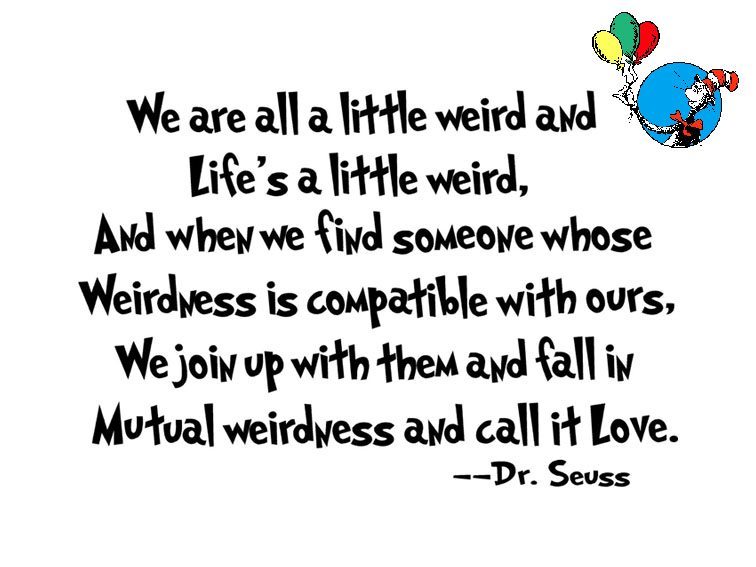
#WeirdEd Week 97- Dr Seuss Part 2


We have only doubled up a few chat topics here on #WeirdEd, but if there's one that deserves to be covered on an annual basis it's the good Doctor himself, Ted Geisel. Way back in Week 46 we chatted about him and since it's his birthday today we should do it again. After all, he is the greatest author of all time.
Yes, the greatest.
I will fight you.
He managed to work deep meaning and heavy messages into children's books on the regular. Even his less deep books, To Think That I Saw It On Mulberry Street for example, still carry the weight of inspiration and message.
I always assumed everyone was a giant Seussiphile. I understand that I get nerdy on stuff (just you wait for the next two weeks I've got planned) but Seuss seemed like someone everyone should just know. Doesn't everyone read his books for fun and seek out the lesser-known titles because they are still gems? The stuff you don't know as well as you know The Sneetches or The Lorax like The Butter Battle Book or Yertle the Turtle are heavy with darkness and meaning.
Let's take The Butter Battle Book as an example, since I read it to my class yesterday and it's fresh in my mind-
TBBB takes place in a land of Yooks and Zooks. Yooks eat their bread butter-side up and the Zooks, with "kinks in their souls" eat bread with the butter-side down. He's completely open about how angry this difference makes the Yooks and already your adult brain is making connections. The Yooks are so insulted by the Zooks, in fact, that they've got a Wall built separating their two countries. Oh, a wall? Hmm, now this came out in 1980 so that's not the wall we're all thinking about in 2016, but it echoes just the same. Our main character, a Yook soldier, is sent to the wall to take out Van Itch, his Zook counterpart. Each time he returns to the wall with a bigger, more dangerous weapon and each time he's met by Van Itch with either an even bigger weapon or the same weapon and a promise that if you hit us I'll hit you. The capabilities of the weapons become less and less defined until even the Yooks in charge admit they don't know what they'll do. And it ends with our hero and Van Itch perched on the Wall, each holding a Big Boy Boom-a-roo, waiting for the other to give an excuse to drop it.
That's where it ends. A children's book. Ends without an ending. Right in the heart of the cold war, poised on the edge of mutually assured destruction. It's his darkest book and I love it.
There's a lot to unpack here. There's escalation, which you can keep on a global scale or shrink all the way down to a classroom interaction one. There's propaganda. There's patriotism and xenophobia and blind hate and fighting instead of talking (there are no reasonable voices in the story) and cause-and-effect. And there's more.
Here's the fun thing about this book- I only had to unpack the Cold War metaphor for my kids, they got the rest of that on their own. And once the Cold War stuff is clear the book takes on an entirely new meaning. If my class were just a little bit older I'd have used it as a metaphor for the election. As it was we explicitly talked about hating people for ridiculous differences like color, religion, sexual preference. Were those author intent? I don't care. I can use them.
Tonight let's take Dr Seuss into our classrooms in a better way than a fun rhyming read-aloud, though if you're gonna do that do Fox In Socks because it's the best read-aloud ever.

Tuesday, February 23, 2016

#WeirdEd Week 96- Love Complex- The Chat


I just wrote a post I'm more happy with than anything I've written in a while. I want as many people as possible to read it, not because I'm dying for hit numbers (do you see ads on this page? [ok, aside from my own books, which doesn't count]) but because why I don't need an audience to justify writing something I do like it when I have one. And this last post felt needed an important. 

Tonight's #WeirdEd will use this post as a jumping off point. A conversation starter. It's a lot longer than normal chat posts because it wasn't conceived as a chat post. 

So basically what you're reading right now is a post written to tell you to read a different post. The BlogFather pays me by the link.


Our Love Complex

Teaching should be fun.

That's so trite. It oughta be on a landscape background in a loopy font and have 15 retweets so an edu-thought leader could tweet the same thing on a different background and get 750 retweets.

We do this job for 180 days. More if you count weekends and holidays and add up all the extra time like we love to do. Like we're billing by the hour. Or like we wish we could. Is that why we mention how much extra we work? Should we bill hourly? Lawyers and tattoo artists do. I'm not immune to this, and I wish I were. No one wants to hear how much extra you work.

We want to be called superheroes, but why? We're human. We're people. We work with kids and that's hard but frankly I've seen what my mom does and some of the people she has to deal with on a daily basis and that's not much easier. She's not changing the future though. Just the present. Seems harder to change the present. The future you can aim at and adjust to. To change the present you have to steer into a skid you’re already in.

We teachers put a huge emphasis on the future. We should. That’s our business.

Teaching is a huge part of American culture, but its impact is almost completely under the surface. It’s not a flashy profession, it’s a slow burn, long game. I've said it before, but education is a heavily wonky conversation. It's not easy. Very little in education is straightforward. That's why political talk about schooling is so surface. "Yes, education is good. Yes, teachers should get paid more." Lip service, but we crave it like my three-year old craves Hot Wheels. Everyone knows to say these things. Everyone but the ambulating pile of barely sentient hair follicles known as Scott Walker.

I wonder if sanitation workers have similar gripes. I'm not comparing educating the youth of America with making sure the America they grow up in is clean and nice-smelling, but we both probably feel left out of the conversation a lot. Do they gather together and wonder why no one else is talking about the new sanitation laws that are being passed by the Secretary of the Interior? (I'm not sure what government agency is in charge of this, stay with me.) I'd bet anything they think they should be paid more. Their job is very important to the present of our country. Are there sanitation worker memes? A rainbow over a landfill with pretty text, "If Cleanliness Is Next to Godliness, That Makes Us Angels."


I'm as guilty as everyone else. I want teaching to be recognized as important and listened to as such. Ignore the clown shoes I sometimes wear and remember that important is not synonymous with dour. This job is fun. Kids are fun. Kids are goofy as hell (whether you you let them be or not). And here's where the dour people come in, "Well testing has taken all the fun out of schools." To you I blow a raspberry. I fart in your general direction. I started teaching under Bush the Lesser's Reign of Testing. I worked in a district where, no joke, my language arts curriculum was dictated to the page and the minute. We still found ways to have fun. That year I had my tattoo artist come into my room and teach my students about creativity. I've always taught in a testing grade and I've always striven for joy anyway. This job is fun.

We’ve gotta lighten up about it sometimes. This superhero thing that's going around? That's not convincing anyone. Everyone wants to be a superhero. "I'm a prison guard, what's your superpower?" "I'm a fireman, what's your superpower?" "I'm a server, what's your superpower?" I was a server and that job is hard. Is it equal to teaching? No, of course not. But it could still be a superpower. Do you have any idea some of the dopey superpowers that have existed in comic books? I was a lifeguard. That's a superpower. You're literally saving lives. In the present tense.

We should expect respect because teaching is a profession that deserves it. We should demand to be paid a professional wage. We should stand up for ourselves and our kids. We don’t need to hide behind our love for our kids. We adore reminding everyone that students come to school to be loved and damnit that means we love our students and you should pay us more and respect us more because of how deep our love is.

I'm not sure many jobs get paid by how well they love.

...Ok, I can think of one or two.

But in the public's eyes that's not our job. Our job is to educate our kids. They don't care, really, what the nitty-gritty is, just like we don't care what the newest sensation in garbage collection is. We want it done the best possible way, and we’re decent humans so we want the people who do it to know we respect them by how we treat them and how they are paid. They don’t need to be superheroes. And neither do we.

Stop the cliches. Everyone believes the children are our future. One- Whitney told us. Two- It is literally true. We don't need to remind everyone of it.

I love you all, every single person who teaches. This job is hard and you know it like no one else. You’ve been called to it and that keeps you in it when it gets hard. I want you to keep teaching and keep making yourself a better teacher for your students. I want you to internalize that pride because you're good at it and you love it. Not because someone calls you a superhero.

A Savior Complex does not suit us and will not save us.

Be a Teacher. That’s what the profession needs. That’s what our kids need.

Sunday, February 21, 2016

Bad Science and Swimming Underwater


Sometimes I feel like my classroom is a laboratory. But not in a good way. Not in a everything is organized and scientists are scientifically sciencing with detailed notes and data tables.

My lab is more like that room where people throw things at the wall. Sometimes it sticks. Sometimes it slowly oozes down. Sometimes it hits the fan.

I should be better about this. I should be more detail-oriented. There's a lot of times where I try something and in the back of my mind I know that somewhere on the internet someone has already tried this and they know a better way to do it. And yet, I don't look. I don't want it.

I trust my instincts deeply. I wrote my first book before discovering edutwitter, which means I had faith that the ideas in that first book, good or bad, were mine. I discovered them. I did the troubleshooting and the testing and the trial and error. My subjects were my students. We learned together, we fell together, we rose together, and we corrected together.

Social media has given me ideas but I rarely try to get details for those ideas. I'll take the inspiration but I don't want the work. This is a harder way to go about it. I'm not taking the harder way to be difficult or cool. I take it because then I trust the result. I know how I got to where I got and why I got there. With lessons, plans, ideas, projects, grading, whatever. The ideas are mine or my students'. 

Isn't this bad for my kids, though? Seriously, if there's a book out there that has a great way to teach x aren't I being a bad teacher by not seeking that book out and reading it? Why reinvent the wheel? 

Honestly, because I like reinventing the wheel. My wheels look different than your wheels. And on top of that, my wheels this year are different than my wheels last year. I think it's better for my students in the long run. I'm not advocating ignoring all research or brushing off anyone's ideas and knowledge. But I do want to take your skeleton and hang my own skin on it (that got macabre).

I'm sure this all relates back to my belief that teaching is more art than science. Because it's more art that means it's more about discovery. We're in it together, my kids and I. Together we make art. I'm the guiding hand, I have to be. That's my job. But when there's an easier way I don't always take it because art isn't a smooth process. It doesn't have to be hard, but it shouldn't be someone else's. 

Have faith in your bad ideas. Make them good ideas. Smooth them out. Don't go somewhere asking for permission or approval. Get it done. And if the idea is really that bad you have two choices- bury it in the backyard or put it back in the oven to cook longer.

When I was a lifeguard we used to train doing underwaters. It's exactly what it sounds like- you swim as far as you can underwater. There's two parts to being able to swim a long way like that. The first is skill- you should understand the best way for your body to cut through the water. The second is mindset- you have to decide to Go. You cannot question it. You accept that it'll hurt and you get past that. I learned this as a swimmer and a butterflier. I got faster when I decided to just go and not question. An underwater hurts eventually. Your body fights for air, your lungs burn, and the only way to keep swimming is to relax into the pain. And when you do you learn to trust your body because it'll go farther than the pain would have lead you to believe. 

I learned to trust myself in those laps with my heart pounding in my ears and my eyes focused squarely on the back line running the length of the pool. I trusted that I could do it. I could make it and make it farther than I had before. 

This is part of who I am as a teacher. It looks like confidence, but it's more properly defined as trust. I'm going to try a new thing, I don't know if it'll work, and that's bad science because it's new to me but probably but not new in general. But I'd rather trust myself to find the best way for my students than ask around too much. 

Bad science, but good art. Have faith in what you're creating. You still get to laugh maniacally.  

And I will allow that there's got to be a balance, and I know there are teachers out there who balance the science with the art much better than I do and I want to sit at their feet and learn from them. This is where I am now in my continuum. 

Tuesday, February 16, 2016

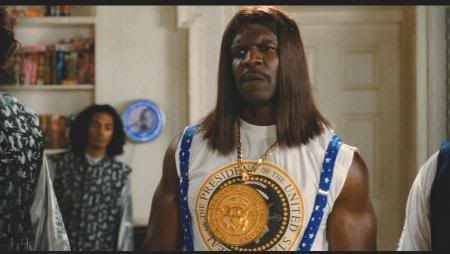
#WeirdEd Week 95- Fictional Presidents' Day


Today a guy running for president of the United States tweeted a picture of a gun with his name engraved on it and one word, "America". Say what you want about this, but this is the message he chose to send to the world about himself. (Or what he wants us to think about him. It rings as hollow as the bullet points he dreams about to me, like a kid acting like he thinks the other kids want him to act.) Politics are an educational issue, and we've not shied away from politics before. What do we want our leaders to know? What should they think? How involved should they be?

But, since we already hit that, I thought I'd take advantage of the recent holiday to talk about what we imagine our presidents could be like. Let's look at our fictional presidents and see how they have inspired our country. What great feats have these (still almost all) men accomplished? Flying a fighter jet at an alien spaceship*. Sleeping with a lobbyist. Caving to the Cylons. Getting baddies the hell off his plane. Being shouted at by Corbin Dallas' mom. Being the only president who is also a wrestler and a porn star.

"Doug," you shout. "Surely you can't make these presidents relate in some way to education? I mean sure, once you wrote a whole chat about narwhals, but this is going too far!"

Oh is it, audience who lives in my head? Movies are where we put our aspirations and our dreams (see Bartlett, Jed) and our fears (see Bush, Jeb!**). In the movies we imagine a leader who looks upon an asteroid falling from the sky and knows just what team to call. This, without a doubt, is a president who can handle Common Core. President Scroob, even with his head on backwards, would know that we're overtesting our students. When the Martians attack (having learned about Earth culture from Matt Damon) Jack Nicholson will be there to defend our education system. And we know Jack Stanton (who's fictional in name only) could talk his way through any funding quandary.

*WHY are we getting a sequel? Who asked for that?

**he's not fictional yet, but he will be